
Marion County Marriage License
The Marion County Clerk's Office Marriage License Division is at the City-County Building, Suite W122. The division uses phone 317-327-4720 and marriage@indy.gov. The Clerk's process requires an online marriage license application, in-person application review, and then a ceremony performed by an authorized officiant who returns the signed license for recording.
Both applicants must be at least 18 years old and must present physical, unexpired identification. Acceptable examples in the research include a valid driver's license, current state-issued ID card, original certified birth certificate, or passport. Proof of residency examples include a rental lease, valid driver's license, state ID card, or current utility bill.
The local process appears in the Marion County marriage license process source capture.
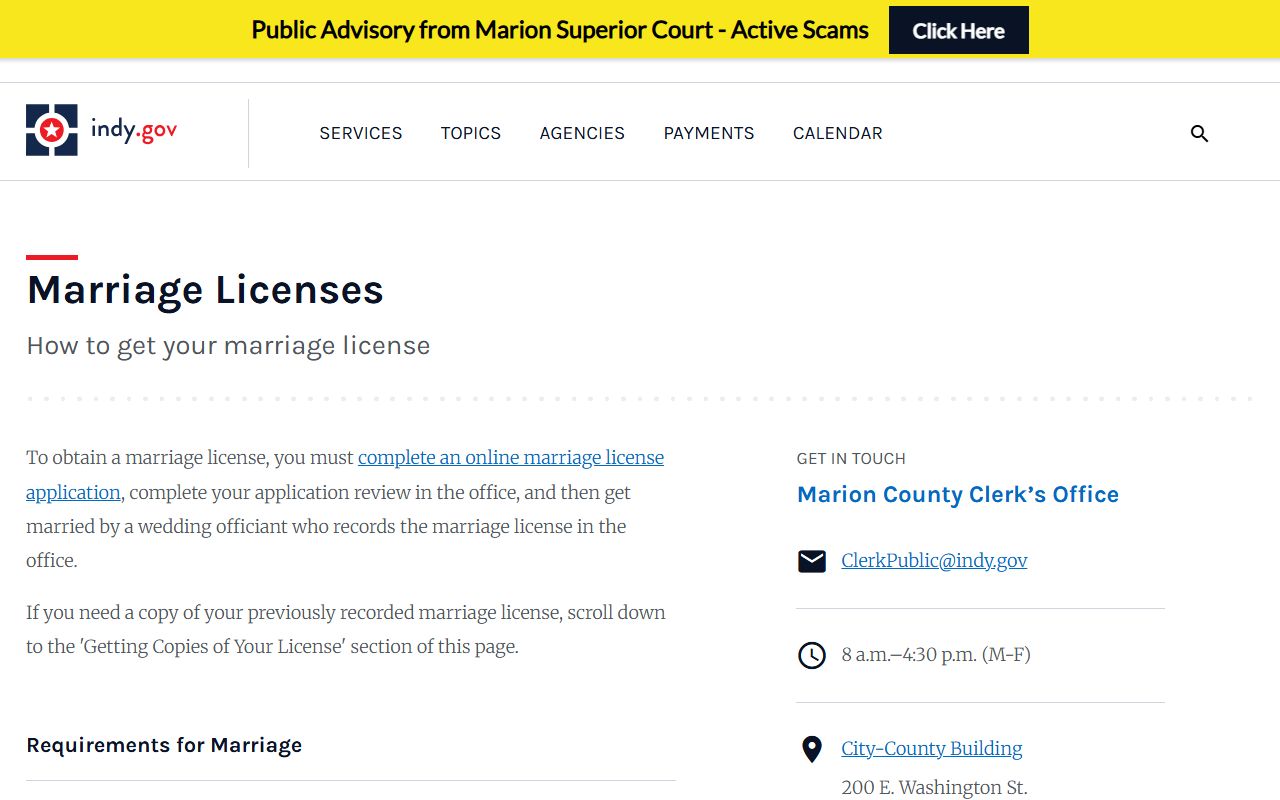
The image supports the main local rule: the online application starts the process, but the Clerk's in-person review is still required before issuance.
Apply for Marion County Marriage License
Applicants complete the state online application before going to the Clerk's Office. No appointment is necessary because the Marion County page says couples are accepted on a walk-in basis only. A deputy clerk reviews the online application, asks questions, checks documents, and collects the fee.
- Complete the online marriage license application through the Indiana marriage license application portal.
- Both applicants go to the Marion County Clerk's Office for in-person application review.
- Bring physical, unexpired identification and proof of residency when required.
- Answer the deputy clerk's review questions and pay the proper resident or nonresident fee.
- Use the license within 60 days, then make sure the officiant returns it for recording.
The statewide marriage application portal appears in the Indiana online marriage application source capture.
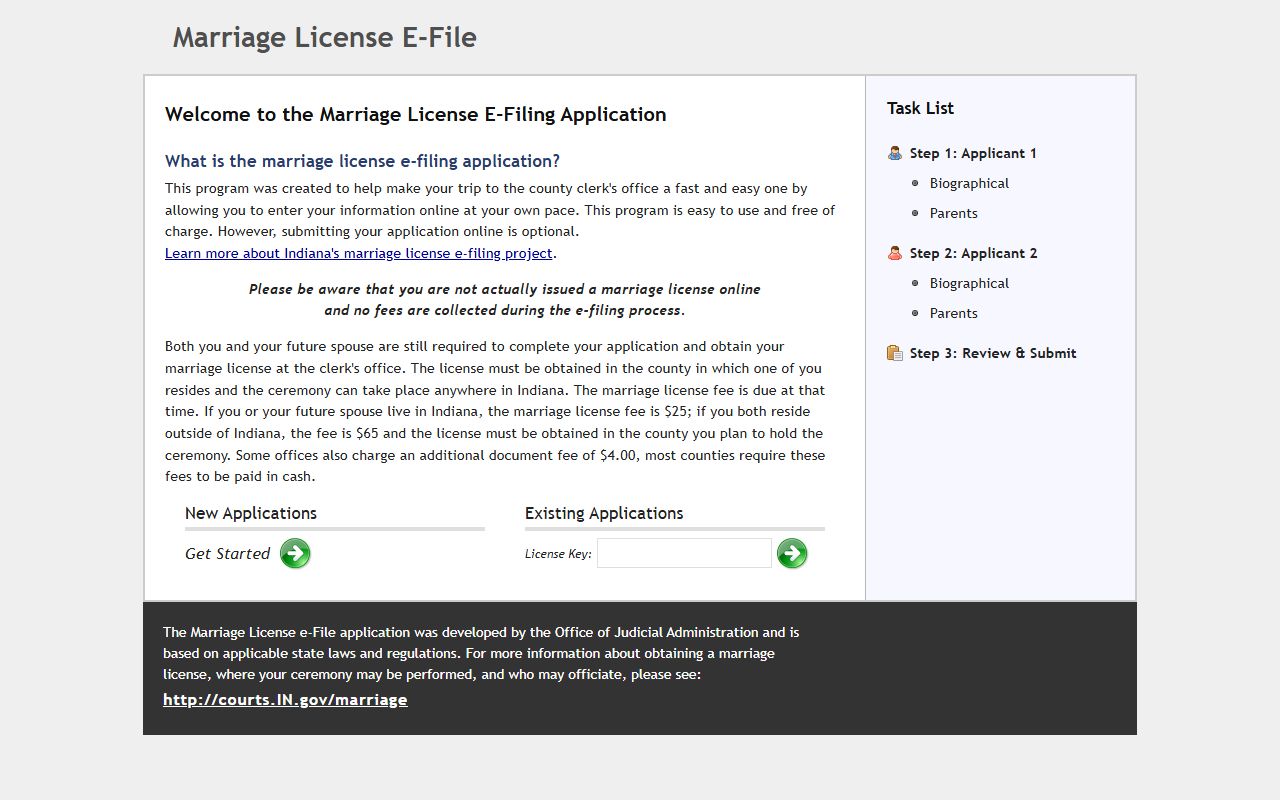
The portal image shows the state application channel that Marion County applicants use before the local Clerk review.
Marion County Marriage Limits
The Clerk cannot issue a marriage license in several listed situations. Either applicant being under the influence of drugs or alcohol during the application can block issuance. Close family relationships are barred when applicants are more closely related than second cousins, except first cousins may marry if both are at least 65. A person judged of unsound mind cannot apply unless the adjudication has been removed.
A lifetime sex or violent offender must submit the required affidavit about written notice of intent to marry and intended married name to local law enforcement in both the county of conviction and the county of residence. Indiana residents from another county should apply in their home county. Out-of-state visitors marrying in Marion County apply in Marion County.
License timing: A Marion County marriage license is valid for 60 days, and the signed license must be filed after the ceremony.
Marriage Record Search Fields
The research did not expose every runtime field of the online marriage application, so the page should not invent a full applicant form. The public marriage license lookup fields were available and are useful for finding recorded Marion County marriage records. The lookup uses applicant-neutral labels even though older underlying HTML may still refer to groom and bride field IDs.
| Field Label | Type | Required | Notes |
|---|---|---|---|
| Applicant 1 Last Name | Text | At least one applicant last name | Search tips say to enter at least a last name for either applicant. |
| Applicant 1 First Name | Text | No | Narrows search. |
| Applicant 2 Last Name | Text | At least one applicant last name | May be used instead of Applicant 1 last name. |
| Applicant 2 First Name | Text | No | Narrows search. |
| Marriage Year From | Number | No | Example format in research: 1995. |
| Marriage Year To | Number | No | Example format in research: 2001. |
| County Issued | Multi-select | No | Choose Marion, value 49, or multiple Indiana counties. |
Marion County Marriage Fees
Marriage license fees depend on residency. Marion County's marriage process research states that Indiana residents pay one amount and out-of-state residents pay a higher amount. Cash and credit or debit cards are accepted for the license fee, with an extra card processing charge. Certified marriage copies by mail use the separate Clerk copy process.
| Item | Amount / Rule |
|---|---|
| Indiana resident marriage license | $25 |
| Out-of-state resident marriage license | $65 |
| Card processing | Extra processing charge for credit or debit cards |
| Physical court or record copies | $1 per page through Clerk copy channels |
| Certification | $3 regardless of number of pages |
| Certified marriage copy by mail | $4 money order for each copy, plus completed form and self-addressed stamped envelope |
Divorce filing fees were not located in the assigned research sections, so the table does not invent a Marion County divorce filing amount.
Marion County Marriage Recording
The officiant must verify the information on the license, sign and complete the officiant section, and return the license to the Clerk's Office. The Marion County page states that until the license has been recorded, the couple has not been married under Indiana law. Indiana Code 31-11-4-17 requires the signed license to be filed with the Clerk within 30 days of the ceremony.
Authorized officiants under the researched Indiana marriage law include clergy, judge, mayor within the mayor's county, city or town clerk or clerk-treasurer, clerk of the circuit court, governor, lieutenant governor, member of the General Assembly, Friends Church, German Baptists, Bahai faith, Church of Jesus Christ of Latter-day Saints, and imam of a masjid.
The Indiana marriage law source appears in the Indiana marriage law source capture.
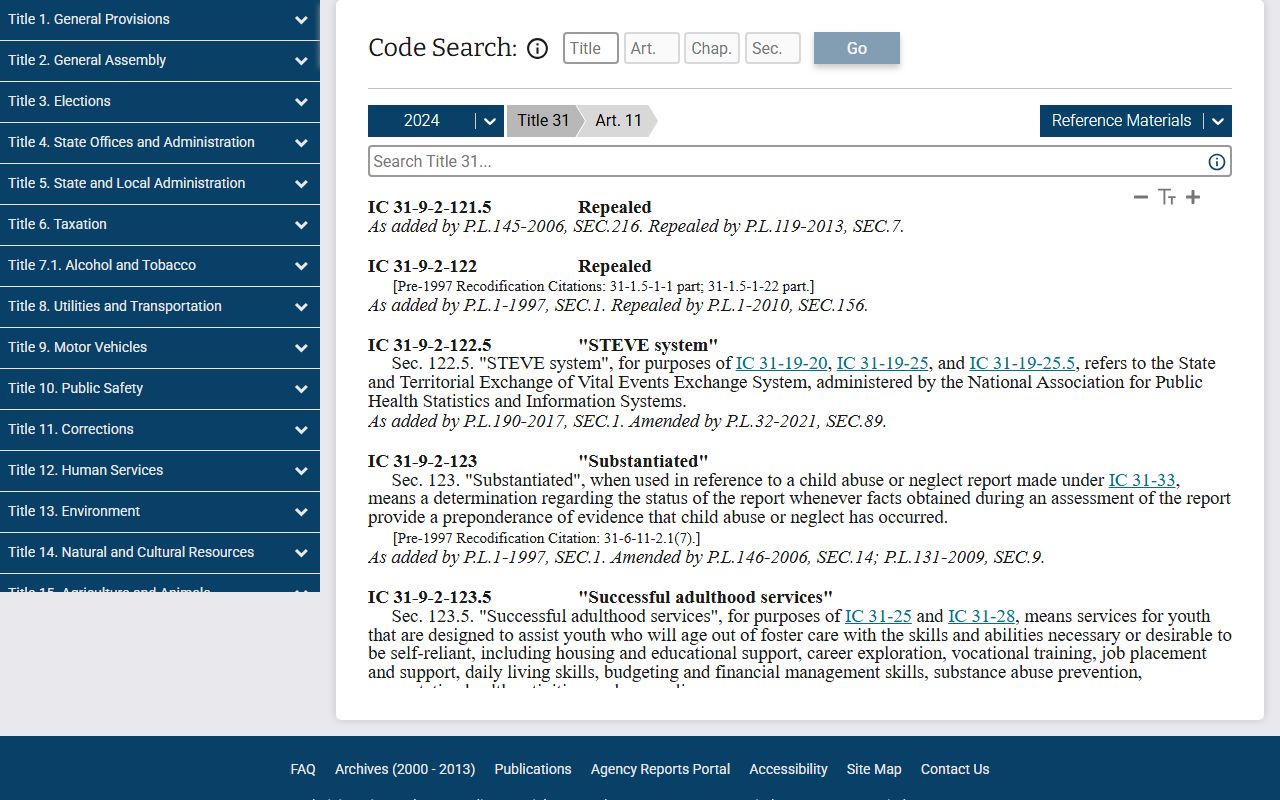
The source image supports the statutory background for eligibility, issuance, officiants, and recording requirements used by the Clerk.
Look Up Marion County Marriage Records
Public marriage license records can be searched through the Indiana Marriage License Public Lookup. The lookup contains many, but not all, Indiana marriage records from 1993 to the present. The public lookup itself tells users to contact the County Clerk of the Court that issued the license if confirmation is needed.
Use applicant last names, first names when known, a year range, and County Issued set to Marion when the license was issued locally. If the marriage was issued in a different Indiana county, Marion County directs requesters to that county's clerk. Birth and death certificates are not held by the Clerk.
The public lookup appears in the Indiana Marriage License Public Lookup source capture.
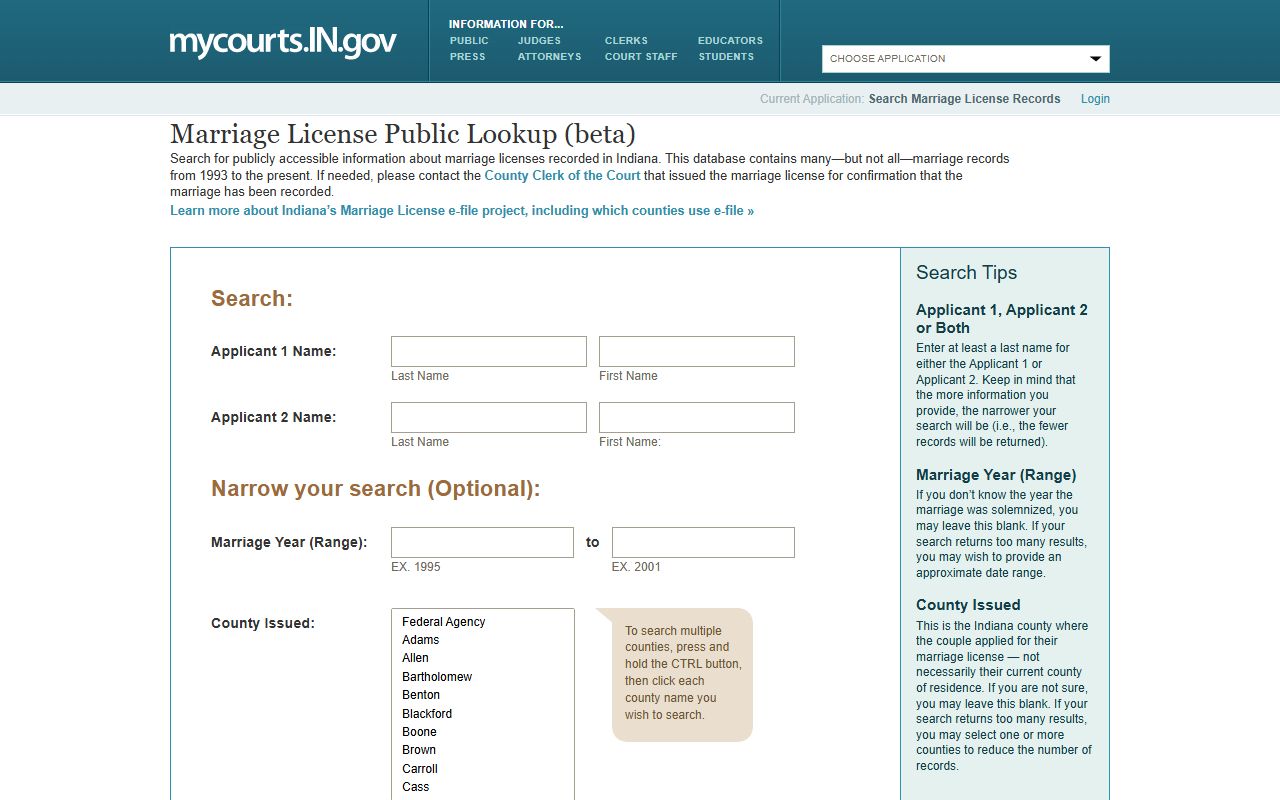
The lookup image supports the record-search channel, but the Clerk remains the confirmation and certified-copy source when the public index is incomplete.
Certified Marion County Marriage Copies
Marriage record copies are available through the Clerk's request channels. In-person copy requests can be made at the City-County Building, 200 E. Washington St., Indianapolis, IN 46204, or at the Community Justice Campus, 675 Justice Way, Indianapolis, IN 46203. Hours are Monday through Friday, 8:00 a.m. to 4:30 p.m.; the research says to arrive between 8 a.m. and 4 p.m. for same-day locating.
Mail requests for certified marriage copies require the completed form, a self-addressed stamped envelope, and a $4 money order for each certified copy. Online requests use the Clerk record request portal. The general Clerk copy rules also apply to court and divorce records: $1 per physical page, $3 for certification, and no personal checks.
The statewide marriage license information source appears in the Indiana marriage license information source capture.
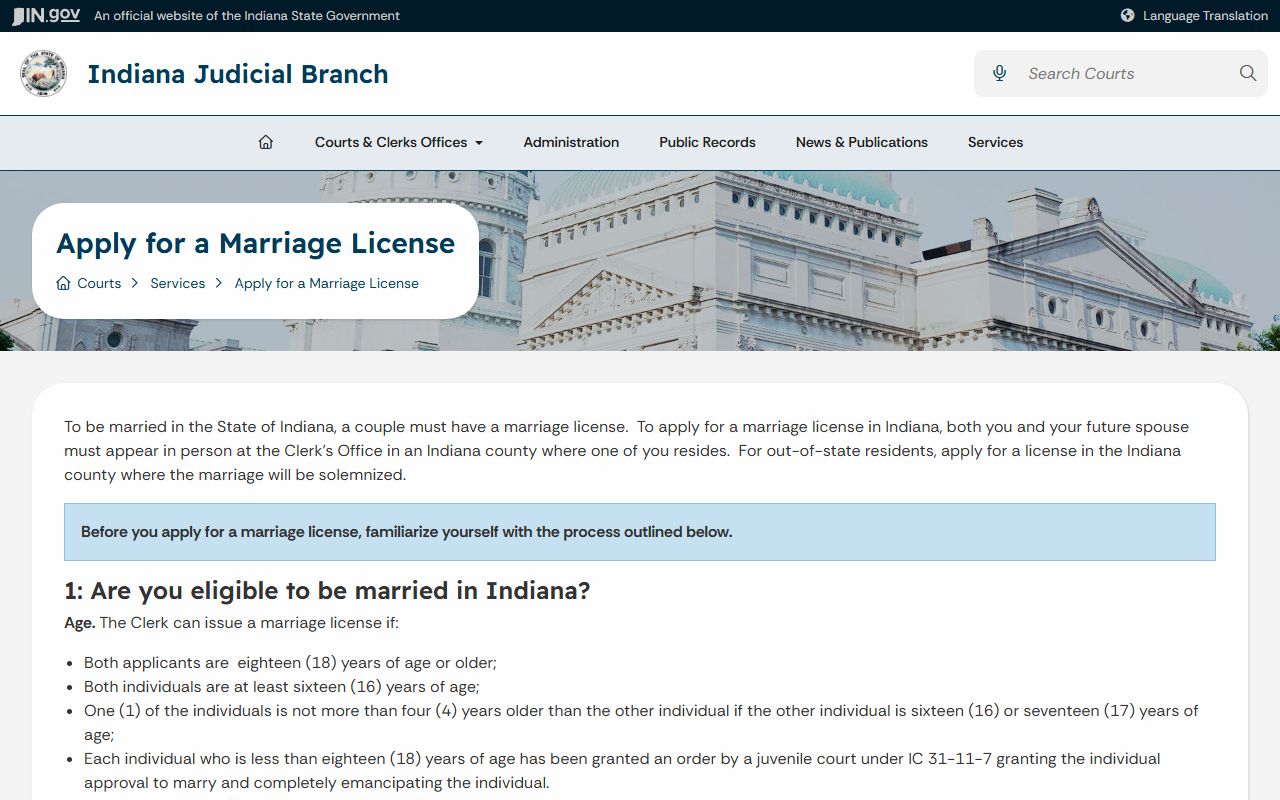
This image connects the Marion County copy process to the statewide marriage license system that supports Indiana applicants.
Find Marion County Divorce Records
Divorce decrees are court records requested through the Marion County Clerk's online record request tool or through the printable Divorce Decree Records form. Divorce case status may also be searched in MyCase under civil or family records when the case is public and in the state case management system. The Clerk's record request portal covers divorce decrees, civil case files, orders, judgments, and other court documents.
If the divorce was filed in another county, request the decree from that county's clerk. Family cases can include restricted material, so a public MyCase entry or public copy request may not include every document in the file. Adoption records, juvenile matters, sealed records, expunged records, and personal identifiers are restricted under Indiana access rules.
- Search MyCase by party name or cause number when the divorce case is public.
- Use the Clerk online record request portal for decree copies or certified copies.
- Use the printable Divorce Decree Records form when mail or paper request is preferred.
- Visit the Clerk at the City-County Building or Community Justice Campus for in-person copy help.
Restricted Family Records
Indiana court access rules limit public release of some family, juvenile, and protected records. Juvenile court records require party-of-record status and valid ID, and the Clerk does not release juvenile pending-action, motion, payment, fee, or restitution information by phone, mail, or email. Adoption records are confidential. Protection order victim-identifying data is excluded from online public access.
Sealed and expunged records are not available through ordinary public search. Divorce records may include public docket and decree information while still restricting financial account numbers, minor names, protected addresses, and sensitive filings. If MyCase does not show a document, the Clerk can explain whether a copy channel exists or whether access is restricted.
- Certified copy
- A Clerk-issued copy with official certification for legal use.
- Marriage license
- The document issued before the ceremony and recorded after the officiant returns it.
- Divorce decree
- The court order ending the marriage and setting the final terms.
- Sealed record
- A court record closed from ordinary public inspection by law or court order.