
Marion County Warrant Search Limits
Marion County warrant records do not start with a single official active-warrant search table. The research file found no broad public Marion County Sheriff's Office database for all current arrest warrants. That matters because a name-only search on a private site can miss recalled warrants, sealed warrants, bench warrants tied to a specific cause number, and tax warrant records that are not criminal warrants.
The official path depends on the type of warrant. A person who believes a criminal warrant may exist can use the Marion County Safe Surrender program, search the public case in Indiana MyCase, contact the court that issued the order, or request public information through the Marion County Sheriff's Office records request channel. The Sheriff serves criminal warrants and enforces court orders, but MCSO public records are separate from Clerk court records.
The Marion County warrant search should also distinguish court status from custody status. A bench warrant can appear as part of a criminal case, while booking and release details belong with jail records. A person who has been arrested on a warrant may later need the jail lookup for custody status and the court case for the next hearing, bond, and disposition.
The official Safe Surrender page is shown in the Marion County Safe Surrender source capture.
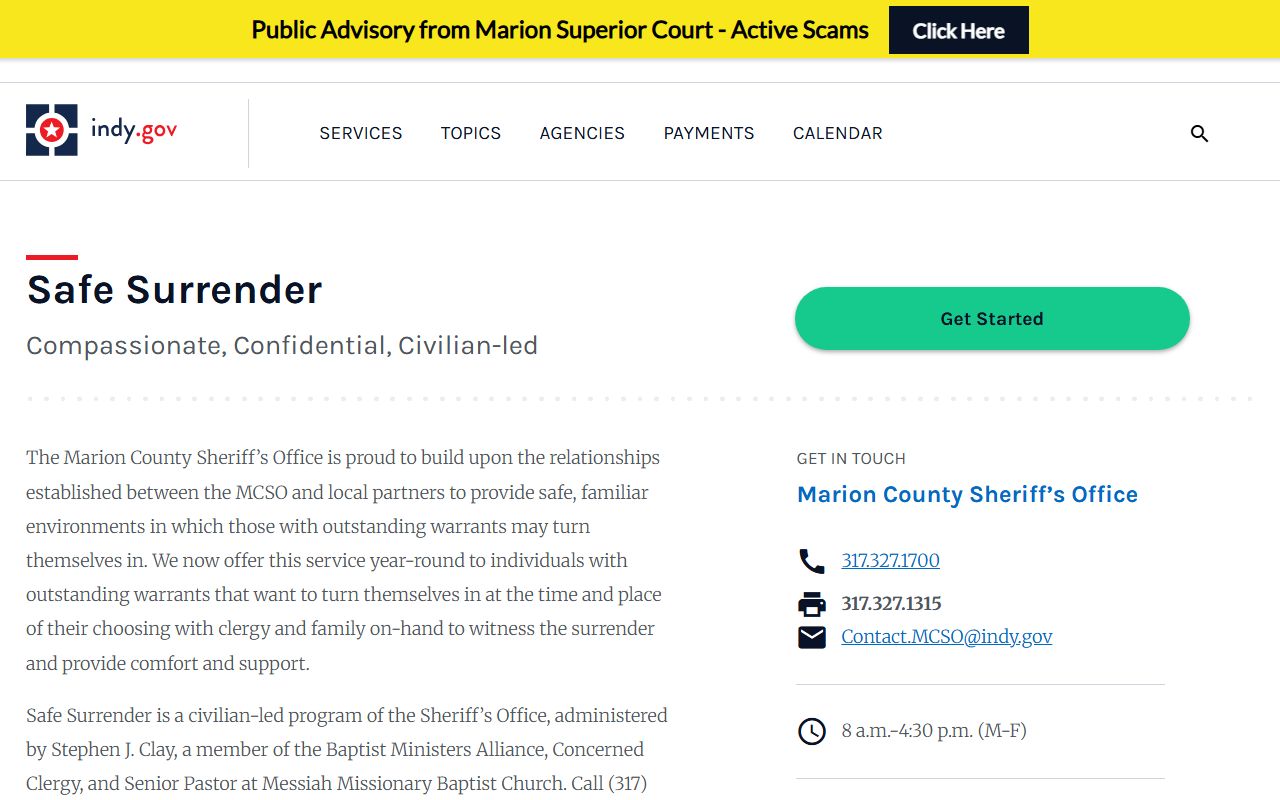
That image supports the main local finding: Safe Surrender is a warrant-resolution path, not a public list of every active Marion County warrant.
Resolve Marion County Warrants
Safe Surrender is the clearest official Marion County warrant resolution channel found in the research. The program is tied to the Sheriff's Office and lets a person begin a review through the official Get Started workflow, by calling 317-327-SAFE, or by emailing SAFE@indy.gov. The program should be treated as a contact and resolution route for people who believe they may have an eligible warrant.
Safe Surrender does not replace the court record. If a cause number is known, MyCase can show public case status, court division, hearings, bond events, and some active warrant indicators when those fields are public. If the court has sealed the case or the warrant is not displayed online, the issuing court, Clerk, or Sheriff's Office may still be the right contact.
- Start with Safe Surrender if the concern is an eligible Marion County warrant and voluntary resolution is the goal.
- Search MyCase by cause number or name when a public criminal case is known.
- Contact the court division or Clerk when the case record shows a hearing, bond, or warrant-related entry.
- Use the Sheriff's Office records request channel for non-emergency public-record questions held by MCSO.
- Confirm final recall or satisfaction with the court or agency because online systems can lag.
Important: A person facing arrest should ask the issuing court, counsel, or Safe Surrender about bond and appearance requirements before going in.
Marion County Warrant Types
Warrant language in Marion County can refer to criminal court orders, tax collection records, search warrants, or custody holds. Treating them as one record type causes bad searches. A bench warrant for failure to appear is court-driven. A tax warrant comes from Indiana Department of Revenue liability information recorded through Clerk systems. A search warrant may be sealed before it is served and may never appear as a normal public name search.
| Warrant Type | Where to Start | Key Marion County Detail |
|---|---|---|
| Arrest warrant | Safe Surrender, MCSO, issuing court | Used for criminal allegations or court orders authorizing arrest. |
| Bench warrant | MyCase and court division | Often tied to failure to appear, probation violation, or contempt. |
| Search warrant | Issuing court or law enforcement | May be sealed before execution and may not be searchable by the public. |
| Fugitive hold | Jail portal, MCSO, other jurisdiction | Custody may be based on another county, state, or federal agency. |
| Tax warrant | Clerk and IDOR channels | Not a criminal arrest warrant and not proof of jail custody. |
| Civil body attachment | Court handling the civil matter | May arise from contempt, child support, or enforcement proceedings. |
MyCase can be useful for criminal bench warrants because public case details may include active warrant indicators, bond records, charge fields, and next hearing information. It is not a Sheriff warrant list. If the public court file is absent or incomplete, use the Clerk, court division, or MCSO fallback instead of assuming no warrant exists.
Marion County Warrant Channels
The best Marion County warrant lookup is a channel-by-channel check. Each source answers a different question. MyCase answers what the public court case shows. Safe Surrender answers how a person may begin resolving an eligible warrant. The Sheriff's Office answers MCSO public-record questions. The Clerk can explain basic tax warrant records and copy channels, but it cannot give a comprehensive list of every new or outstanding IDOR tax warrant.
| Channel | Use It For | Limit |
|---|---|---|
| Safe Surrender | Starting a warrant-resolution process | Not a broad public warrant database. |
| Indiana MyCase | Public criminal case status, hearings, bond, and possible active warrant indicators | Sealed, confidential, expunged, and some restricted cases are not shown. |
| Court calendar or slates | Initial hearings, bail reviews, violation hearings, and court dates | Calendar entries are not a warrant lookup tool. |
| MCSO records request | Sheriff-held public records and non-emergency records questions | Does not replace court orders or legal advice. |
| Tax warrant page | Basic tax warrant questions and contact path | Detailed files and payment confirmation are with IDOR. |
| Phone or in-person contact | Urgent verification with the issuing court, Sheriff, or Clerk | Juvenile and confidential data may not be released. |
For an unresolved warrant, the safest practical chain is court case, court or Clerk contact, and then MCSO or Safe Surrender as appropriate. For a tax warrant, use the separate tax warrant contact route. For a custody hold, confirm with jail records and the agency that placed the hold.
Marion County Warrant Record Fields
When warrant details are public through a court case or related record, they usually appear as parts of a larger case file instead of a standalone warrant card. Marion County examples in the research connect warrant information to cause number, court division, charges, bond, and future hearings. Those details should be read with the case status and the source date.
| Field | What It Shows |
|---|---|
| Cause number | Indiana case number, often beginning with Marion County code 49. |
| Issuing court | Circuit Court or Marion Superior Court division that entered the order. |
| Person name | Defendant or person tied to the warrant when the record is public. |
| Charge or case type | Underlying criminal, contempt, tax, or enforcement matter. |
| Warrant type | Bench, arrest, search, fugitive hold, tax warrant, or other court order. |
| Bond information | Bond amount, no-bond status, or bail review event when public. |
| Status | Open, recalled, satisfied, or otherwise resolved if the source displays it. |
| Next hearing | Future court date connected to the warrant or underlying case. |
Note: MyCase financial and status information may lag, so the Clerk or issuing court is the source for official balances and final status.
Marion County Tax Warrants
Tax warrants need separate treatment. The Clerk's record-copy research says basic Indiana Department of Revenue tax warrant information can include warrant number, name and address of the business or person, amount due, and status as open or satisfied. The Clerk cannot provide a full list of all new or outstanding tax warrants, and only IDOR can confirm partial payments or complete tax details.
The official Marion County tax warrant page provides the local contact path. Tax warrant questions may use 317-327-2448, while IDOR questions start with 317-232-2165 as directed by the Clerk's tax warrant guidance. These records can affect liens and tax collection, but they are not arrest warrants.
The tax warrant contact path is shown in the official Marion County tax warrant source capture.
The source image reinforces the page's main distinction: a tax warrant is handled through tax and Clerk channels, not through a criminal active-warrant roster.
Restricted Marion County Warrants
Indiana access rules limit what can be released about some Marion County warrant records. Juvenile court records require party-of-record status and valid identification, and the Clerk does not release pending-action, motion, payment, fee, or restitution information for juvenile records by phone, mail, or email. Protection order information may also be excluded from MyCase because protected-person identifiers are restricted online.
Sealed and expunged criminal records do not appear through ordinary public search. Search warrants may be sealed before execution. A granted expungement can change public access even if a prior entry once appeared in MyCase. The Indiana Access to Court Records Rules, Rule 10 excluded-records list, and Indiana Code 35-38-9 are the controlling sources for many of these limits.
- Sealed record
- A court record closed from ordinary public inspection by rule or court order.
- Expungement
- A statutory process that removes or limits public access to eligible arrest, charge, or conviction records.
- Bench warrant
- A judge-issued warrant, often for failure to appear, contempt, or probation issues.
- Tax warrant
- A civil tax collection record, not a criminal arrest order.